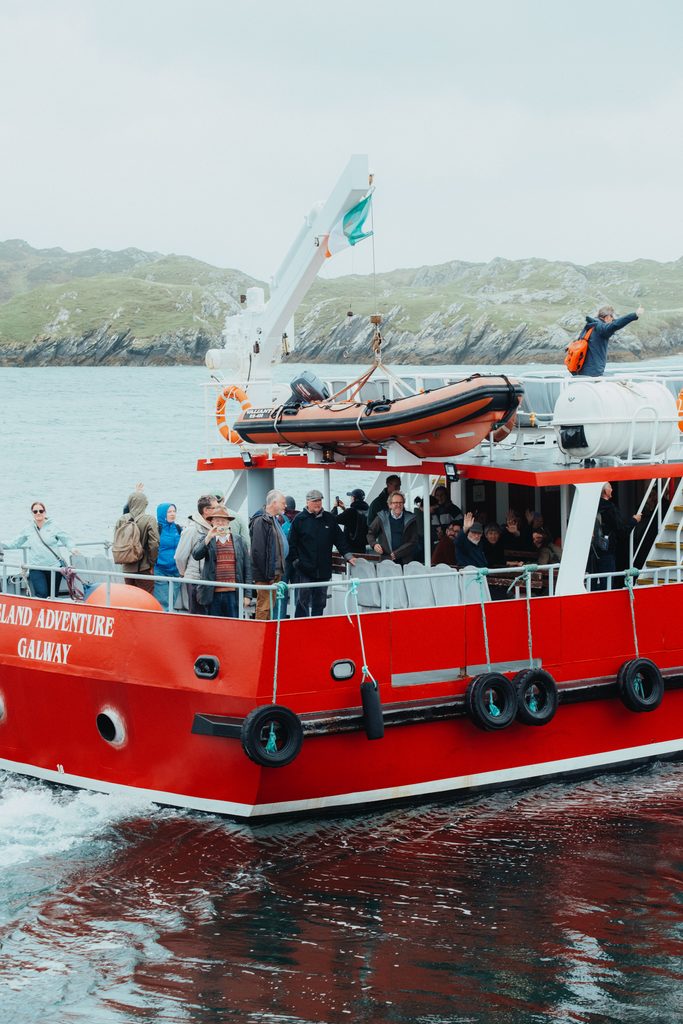
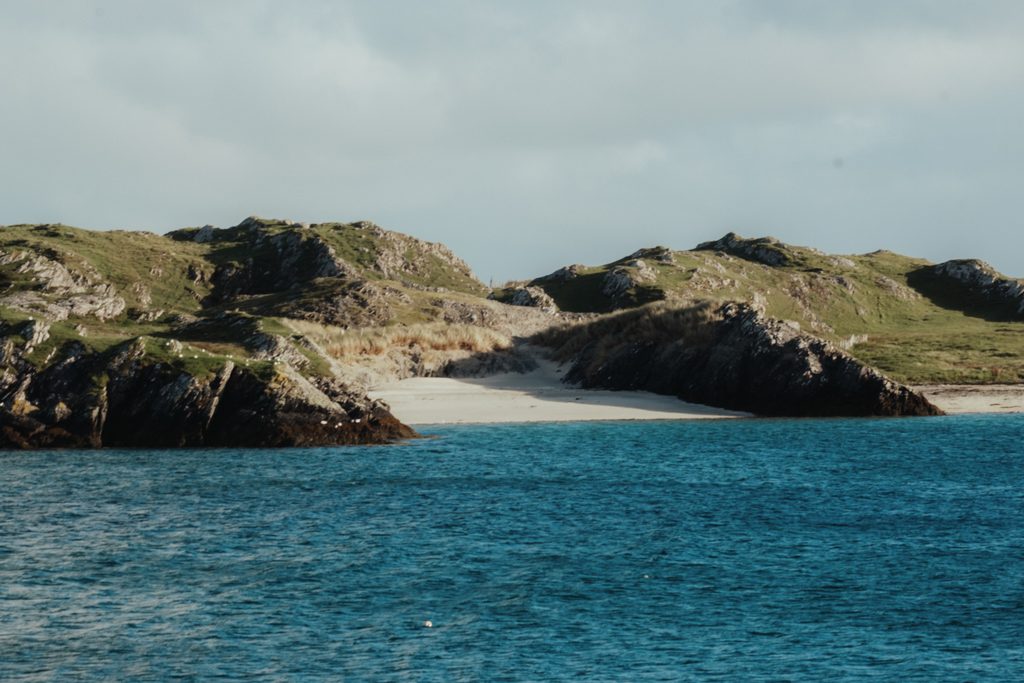
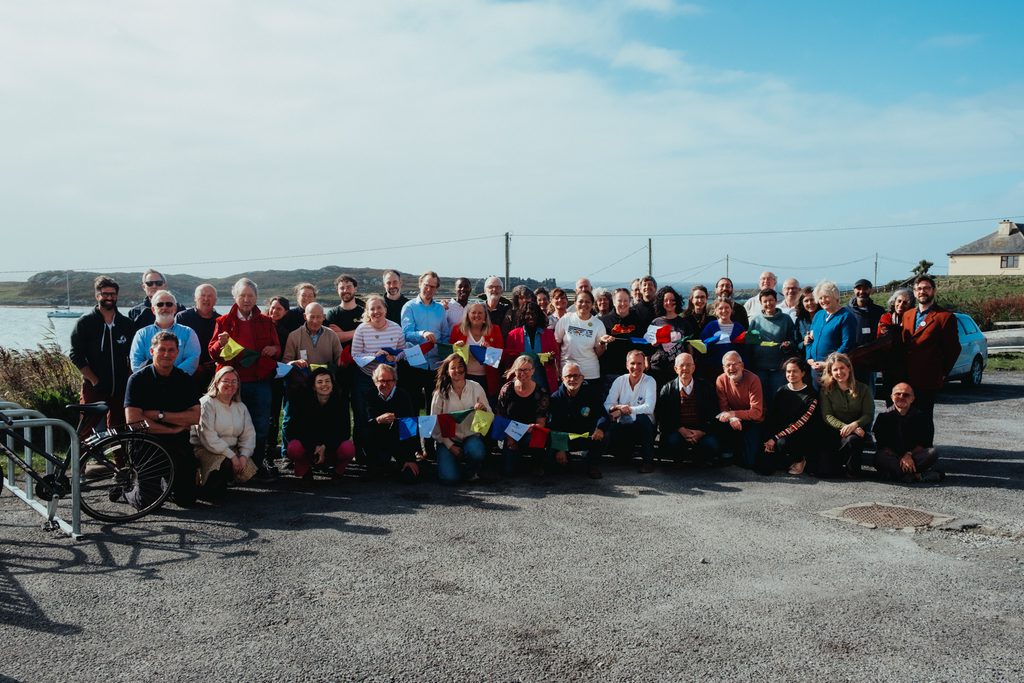
60 participants from around the world gathered on Inishbofin, Co. Galway from 14th-17th September, 2026 to consider what are the political, social and cultural obstacles to action on climate change, and how can they be overcome?
INISHBOFIN
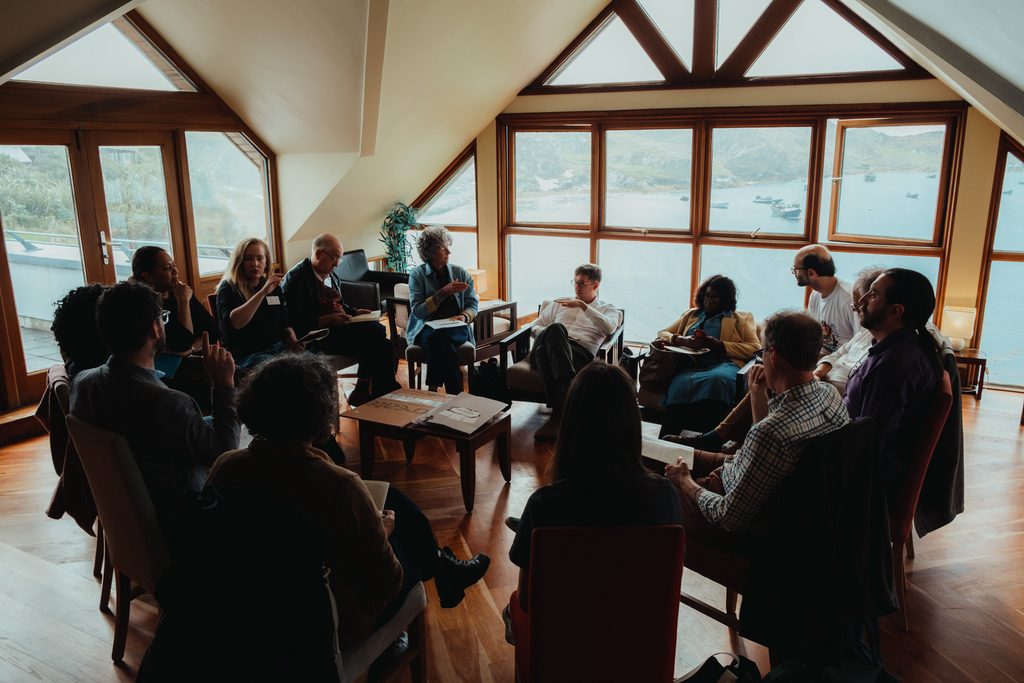
Inishbofin is an island positioned off the western Atlantic coast, offering dramatic scenery, a rich history and a strong local community, who are increasingly aware of the more powerful storms that climate change is bringing. This setting was the backdrop to four days of collaboration, guided by smaller group discussions organized around four thematic strands.
STRANDS OF DISCUSSION
Politics
This strand focused on:
- How well are our political systems serving us in working towards solutions for climate challenges?
- COP and international negotiations
- The challenges posed by data centres and AI
- How to engage and collaborate effectively with those who oppose climate solutions / policies?
- The integration of differing urban and rural perspectives
Significant discussions then explored:
- Strategies to shape a narrative palatable to people on the right in the USA.
- How to establish safety in the management of the global economic system ?
- Strategies to explore how top-down and bottom-up processes can be co-ordinated and mutually supportive to develop strong government policies (with an emphasis on decisions being made at the lowest possible levels)
- The notion of ‘responsible capital’ – rebalancing economic systems
- Regulation of AI, including embedding ‘morality’ in the regulation
- The requirement for financing systems beyond the global North
- The development of policies ready to be deployed in moments of crisis
- Establishing a global carbon tax
- Establishing the indigenous economy of ‘enough’
Spirituality / Ecojustice
SPIRITUALITY / ECOJUSTICE STRAND REPORT
This strand focused on:
- The struggles that those working in this space encounter
- The amount of time required to work, understand and make progress on climate matters
- The type of leadership that is required
Significant discussions then explored:
- The needs to establish sanctuary (not just physical sanctuary), to connect with nature, experience awe and shift from ‘being’ to ‘doing’
- The need for strong, fierce, radical collaboration
- The need to maintain ‘active hope’ in the action
- The requirement to build the capacity for resilience and rescue
- The need to generate new stories
- The need to have imaginative leadership, combining power and empathy to unlock agency
Narrative
The focus of this strand was on understanding the multilayered nature of narratives, in particular the need to pay attention to the role of identity.
The initial sensing of the territory raised interesting questions:
- Which are more effective – positive or negative narratives?
- Are we dealing with universal or pluriversal narratives – all for one or one for each?
- What stories are we not hearing and who are we not hearing from?
The next layer of sensing revealed a categorisation of narratives:
- Throughtopian’ narratives – narratives to help us make it through;
- ‘No-brainer’ narratives – narratives that make sense are smart and more;
- Recognising possible drives – safety/threat reduction; health/survival; money; pride/virtue; status/success; self-reliance/autonomy; luxury/self-indulgence;
- Narratives with Resonance: that respect and build upon existing sacred values, working towards unlikely coalitions;
- How can indigenous and local community voices and practices (such as yarning and weaving – story-telling) be used to better reach audiences?
Getting to greater specificity about narratives in the context of climate change:
- Who we are – positive validation of local identity;
- Values – what we care about and meta-narratives;
- What climate-change threatens that we care about and actions that will make a difference and validate our identity;
- Need for government support for processes of community narrative building.
Togetherness
This strand was built on the observation of the Club of Rome to the effect that without sufficient social cohesion nothing else will work. To work together in a safe way three ‘Shambala’ principles were relevant: (i) hospitality; (ii) enquiry and (iii) nowness – dealing with what’s real and present now.
Initial sensing of what this meant revealed the need for:
- caring for humanity and nature as an integral whole;
- finding unifying themes (might money be one such?);
- achieving our objectives, through creating lots of islands of coherence, which can collectively shift global systems to higher levels of coherence.
Going deeper and sensing the elements of a possible way forward there was a need:
- to say ‘enough is enough’ – ‘we don’t accept the status quo anymore’;
- to be ‘Fierce’, in taking this stance, on behalf of our own contexts and the wider world;
- to recognize that there are a million stories to tell and to bring people with us;
- to communicate that our solutions get people out of a crashing system, with climate solutions to economic, security and many other problems.
SOME DELEGATE REFLECTIONS
Ingmar Rentzhog – What Sixty Climate Leaders Learned On Inishbofin
Laura Cook – The Storm at the Skylight: Notes from the Fifth Province
Lorna Gold – Opening Our Hearts on Inishbofin – A Personal Perspective on the ‘Climate Gathering’
Eamon Ryan – What links Ireland to Tuvalu, a tiny coral island on the other side of the world?
Veena O’Sullivan – Santa Marta Ireland Civil Society Offering
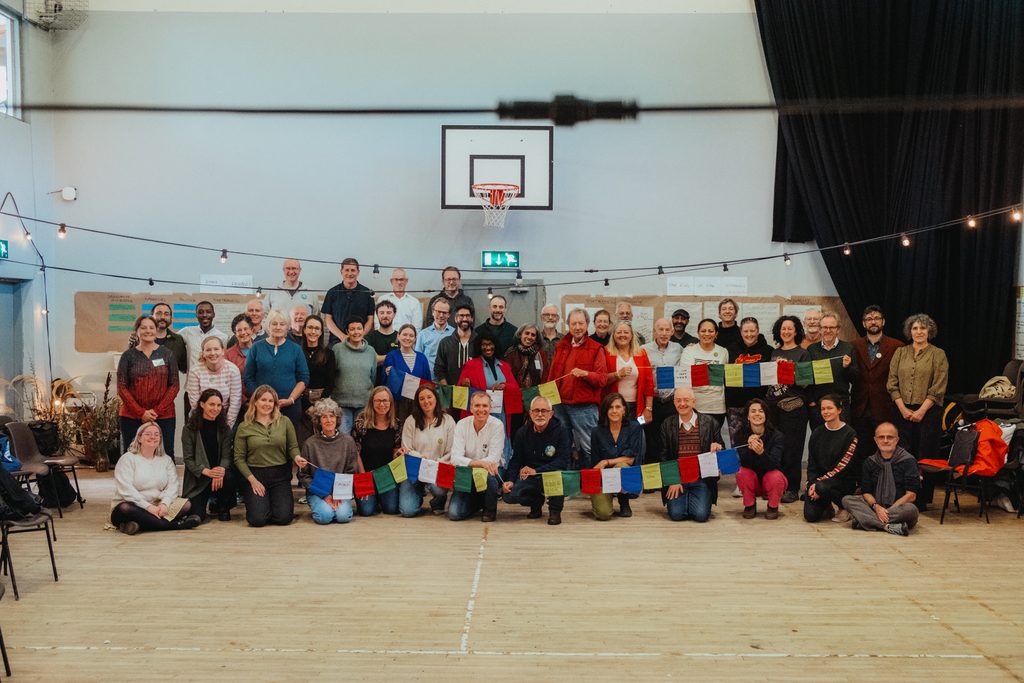
PARTICIPANTS
The following people took part in the Climate Gathering on Inishbofin in September 2026:
Bob Inglis, Former Republican Congressman and Head of Republicen.org
Mary Anne Inglis, Co-Founder of My Neighbor’s Voice
Lorna Gold, CEO Laudato Si movement
Jessica Robinson, Eco Judaism Network; Education Lead
Jean Duff, Women, Faith, and Climate Network Coordinator
Niall Leahy SJ, Director of Jesuit Centre for Faith and Justice
Chris Chapman, Lead Facilitator at ReSource, Burren College of Art
Veena O’Sullivan, International Director of Tearfund
Imam Kamran Shezad, Sustainability Executive for the Bahu Trust
Anthony Giancatarino, Co-Founder, Taproot Earth
Padre Dario Bossi, Latin American Church Mining Network
Allen Ottaro, Network for Environmental Sustainability in Africa (CYNESA)
Paul Watkinson, Former Chair SBSTA and French Climate Negotiator
Phyllis Byrd, Organization of Africa Instituted Churches (OAIC) in Kenya
Nick Bridge, Former UK Special Representative for Climate Change
Ian Kuijt, Department of Anthropology, University of Notre Dame
Stuart Brocklehurst, Director of Green Futures Solutions, Exeter University
Laura Cook, Director, Project Dandelion
Kezia Wright, Environmental advocate and artist
Ruth Gilligan, Professor of Creative Writing, Birmingham University
Scott Heron, UNESCO Chair on Climate Change Vulnerability of Natural and Cultural Heritage
Bobby Fitzgerald, Artist and spoken word poet from the Earth
Adam ÓCeallaigh, Director, Oileán
April DeAngelis, Playwright
Dorothy Cross, Artist
Catherine Nunes, Director, Shaking Bog Festival
Ray ÓFoghlú, Hometree, Development Officer
Martin Hawkes, Founding Member, Burren College of Art
Wolfgang Blau, Global Managing Partner of Brunswick’s Sustainable Business Practice
Aaron Thierry, Wales Institute of Social and Economic Research and Data
Robert Butler, Journalist, Critic, Geographer
Karen Wiltshire, Professor of Climate Science, Trinity College Dublin
Vinny Smith, Founder, Toba Capital
Victoria Smith, Family Office Leader
Br Rodrigo Péret, Churches and Mining Network
George Marshall, Founder of Climate Outreach and Information Network and author of ‘Carbon Detox’
Rory O’Donnell, Co-author, Ireland’s Land Use Review
Róisín Garvey, Former deputy leader of the Green Party in Ireland
Noirin Lynch, Singer, Director of Spirtuality, FCJ Spirituality House, Co Clare
Stiofán Nutty, Management Consultant, Mediator, Horticulturist and Government Advisor
Rudi Roberts, Director, Cataylse Europe
Turlough O’Donnell, Mediator and Member of the Inner Bar in Ireland
Eliala Fihaki, Caritas Impact Lead (Tuvalu, Aotearoa/New Zealand)
James Coyne, CEO Westside Resource Centre Galway
Katy Johnson, Communications Manager, Wellcome Trust
Gearoid Quinn, Former VP Manufacturing and Logistics at Merit Medical Galway
Ingmar Rentzhog, CEO, We Don’t Have Time
Eamon Ryan, Former Minister for the Environment in the Irish Government Climate Gathering Convenor
Dearbhla Richardson, Europe Advocacy Coordinator, Fossil Fuel Treaty Initiative
Susan Adams, CEO, Education for Sustainability
Brendan Roth, Head of Finance, PIE (Pooled Fund on International Energy)
Kate McElroy, Contemporary Artist
Phil Kearney, President, An Taisce (National Heritage Trust of Ireland)
Ronan Palmer, Chief Economist E3G
Clare Patey, Director, Empathy Museum; Award-winning Artist and Curator
Jane Mellet, Church Outreach Manager at Trócaire